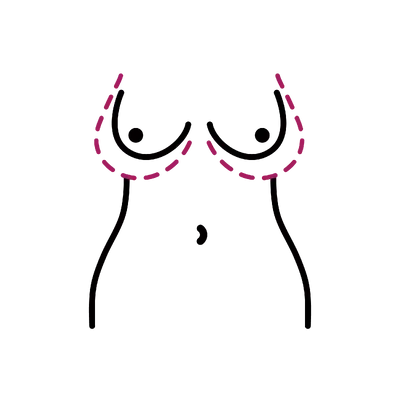
Breast Asymmetry Correction in Thailand Your guide to cost, top surgeons & hospitals
When both sides match, you stop thinking about it. That is the whole point.

What Is Breast Asymmetry Correction?
Also known as: Uneven Breast Surgery · Asymmetric Mammoplasty
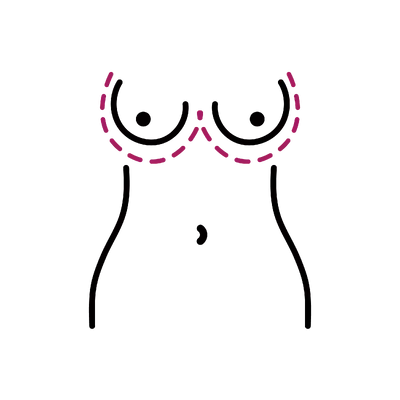
Breast asymmetry correction is surgery that brings the two breasts into closer balance by treating each side with the technique it needs. It evens out noticeable differences in size, shape, projection, or nipple position, and the structural changes are lasting. The work might mean an implant on the smaller side, a reduction or lift on the larger side, fat grafting to fine-tune volume, or a combination, usually under general anaesthesia in about 2 to 3 hours.
Almost everyone has some difference between their sides, so this is not about a flaw. When the gap is large enough that bras never fit both sides, correcting it can quietly take the issue off your mind. Your surgeon assesses each breast on its own and plans the two sides separately.
Honesty matters here. Perfect mirror symmetry does not exist, even in women who have never had surgery, so the realistic goal is a balanced, proportionate result you stop noticing. The two sides also settle at different speeds, so the final shape becomes clear over several months. A consultation is where your surgeon sets out what is achievable for your anatomy.
It can address a range of concerns, including:
Am I a Good Candidate for Breast Asymmetry Correction?
Because each breast gets its own surgical plan, stability, screening, and clear expectations decide suitability more than the asymmetry itself.
Correction only makes sense once your asymmetry has stopped changing.
Development complete: Breast development must be finished before surgery; sides that are still changing invalidate the surgical plan.
12 months stable: Asymmetry that has noticeably changed within the past year is a reason to wait and reassess.
Life changes: Planned pregnancy or further weight change in the near term defers surgery, especially where one side needs a significant reduction or lift.
Surgeons weigh how large and how complex the difference is, because that determines whether surgery is worthwhile.
Half-cup threshold: A size difference of half a cup or more between breasts is the point where correction reliably helps.
More than size: Differences in shape, projection, nipple height, or areola size each shape what is done to each side.
Practical impact: Difficulty finding bras or clothing that fit both sides, or self-consciousness in swimwear and fitted tops, are markers the difference is significant enough to treat.
Underlying breast conditions occasionally drive asymmetry, so screening comes before any cosmetic plan.
Baseline imaging: Ultrasound or mammogram, depending on your age, is needed to rule out an underlying breast condition causing the asymmetry.
No active conditions: Good general health with no active breast conditions is a baseline requirement.
Pre-operative workup: A thorough assessment including imaging and blood work catches issues before surgery, which matters more here because two different operations may be planned.
The goal is balance you stop noticing, not mathematical symmetry, and surgeons look for candidates who accept that.
Balance, not mirror image: Perfect symmetry does not exist naturally; the realistic outcome is proportionate, matched-looking sides.
Two separate plans: Each breast is treated as its own case, which may mean an implant on one side and a lift or reduction on the other.
Uneven healing: The two sides settle at different speeds, so judging the result before 6-12 months is premature.
Who is not suitable for breast asymmetry correction?
- Breasts still in active development
- Asymmetry that has changed within the past 12 months
- No baseline imaging to rule out an underlying cause
- Expecting identical mirror-image breasts
- Planning pregnancy or major weight change in the near term
- A personal or family history of breast cancer, BRCA-positive status, or any active breast malignancy, which must be assessed and cleared before any cosmetic surgery
- Previous radiotherapy to the chest wall (for example after mastectomy), which impairs wound healing and implant tolerance
- Significant obesity or a high BMI, which raises general anaesthesia risk and slows wound healing in multi-technique surgery
- Smokers unwilling to quit at least 4 weeks before surgery
Pricing
How Much Will Breast Asymmetry Correction Cost in Thailand?
What breast asymmetry correction costs at accredited hospitals in Thailand, and what your final quote depends on.
Get your exact price
Tell us what you're considering and we'll send a personalised quote from accredited hospitals within 24 hours.
Get my free quoteTypical prices in Thailand
Typical ranges based on recent hospital quotes. Your exact price depends on the hospital and how complex your case is, and is confirmed at your teleconsultation.
Breast Asymmetry Correction
Breast asymmetry correction treats each side with its own technique to bring the two breasts into closer balance in size, shape, and nipple position.
| Single-side augmentation An implant in the smaller breast to match the other | $3,000 to $4,000 ฿102,000 to ฿136,000 |
| Reduction or lift, one side Reshaping the larger breast down to match the smaller one | $3,000 to $4,500 ฿102,000 to ฿153,000 |
| Combination surgery, both sides A different technique on each breast where one side alone is not enough | $4,500 to $6,000 ฿153,000 to ฿204,000 |
Added to the above where needed
| Fat grafting Added to the main surgery to fine-tune volume or contour | $500 to $1,500 ฿17,000 to ฿51,000 |
Get your exact price
Tell us what you're considering and we'll send a personalised quote from accredited hospitals within 24 hours.
Hospitals Trusted for Breast Asymmetry Correction
From internationally accredited flagships to dedicated specialist hospitals, these are the kinds of facilities where international patients have this procedure.

Bumrungrad International Hospital
Southeast Asia's flagship private hospital, treating over 520,000 international patients a year.
View hospital profile
Kamol Cosmetic Hospital
The only specialist cosmetic surgery hospital in Thailand to hold JCI accreditation.
View hospital profile
Yanhee International Hospital
A 400-bed hospital known worldwide for high-volume cosmetic surgery.
View hospital profile
Get a Free Quote in Two Minutes
Tell us what you're considering. We'll match you with suitable specialists and provide real hospital pricing.
- Honest pricing with no markups
- Matched to a specialist for your procedure
- No obligation, no pressure


Rated 5 stars by our patients
The complete guide to Breast Asymmetry Correction in Thailand
Everything below is for readers who want the full detail: costs broken down, types and techniques, recovery, risks and safety, and planning your trip.
Breast Asymmetry Correction Surgeons & Clinics in Thailand
Asymmetry correction is a planning-heavy procedure. The surgeon matters more here than in most breast surgeries because they need to visualise the endpoint before they start on either side.
Leading Hospitals in Bangkok
Our partner hospitals are JCI-accredited international facilities with dedicated plastic surgery departments. They have the full range of equipment for combination procedures, from 3D simulation for planning to the implant inventory needed to match sides precisely. These are high-volume centres, not boutique clinics.
Experienced Asymmetry Surgeons
Our partner surgeons are board-certified by the Thai Board of Plastic and Reconstructive Surgery. Asymmetry correction requires a surgeon who is comfortable switching between augmentation, reduction, and lift techniques in the same operation. Many of our partners trained overseas and returned to Thailand where the surgical volume keeps their skills sharp across all breast techniques.
What to Look for in a Surgeon
Ask specifically about asymmetry cases, not just augmentation or lift experience. A surgeon who primarily does standard augmentation may not have the planning skill for combination work. Request before-and-after photos of patients with similar asymmetry to yours. Pay attention to how they explain the plan for each side during consultation. If they treat both breasts as one problem rather than two separate cases, look elsewhere.
Understanding Your Results
Asymmetry correction results are permanent, though the timeline for both sides to fully match takes longer than single-technique surgery.
Typical Asymmetry Correction Results
The goal is breasts that look balanced and proportionate in and out of clothing. Common improvements include matched volume, aligned nipple height, and consistent shape between sides. A good result means you stop noticing the difference, not that both breasts are identical, because they never are, even in women who have not had surgery.
What Results Can You Expect?
You will see a significant improvement from the first week, but both sides will be swollen unevenly for the first month or two. The augmented side drops and softens over 3–4 months. Reduction or lift scars continue maturing for 12–18 months. Most surgeons use clinical photography and measurements during consultation to set clear expectations. The consultation is where you establish what is achievable with your anatomy.
Breast Asymmetry Correction Cost in Thailand
Average Cost of Breast Asymmetry Correction
Breast asymmetry correction in Thailand typically costs between $3,000 and $6,000, depending on the combination of techniques involved. A single-side augmentation sits at the lower end, while dual-sided surgery combining implant, reduction, and lift pushes toward the higher end. The price reflects the complexity; this is not a one-size-fits-all operation.
Cost Breakdown
The surgeon's fee makes up the largest portion and reflects the technical complexity of planning and executing different techniques on each breast. Hospital and theatre fees cover the facility, operating room, anaesthesia monitoring, and nursing care. If implants are used, they are itemised separately. Aftercare includes follow-up visits, medications, and coordinator support during your recovery stay.
What Affects the Price?
The main variable is how many techniques are combined. Single-side augmentation is the simplest and cheapest. Adding a lift or reduction on the opposite side increases the operative time and surgeon's fee. Fat grafting adds another layer if used for fine-tuning. Surgeon experience with combination breast work also factors in; this is a case where going with the most experienced option is worth the cost difference.
Thailand vs International Price Comparison
Breast asymmetry correction in Thailand costs 40–60% less than equivalent multi-technique surgery in the US ($8,400–$15,000), Australia (A$7,800–A$13,500), and the UK (£6,600–£11,400). The savings are especially significant here because combination surgery at home involves multiple technique fees stacked on top of each other. Our partner hospitals hold JCI accreditation and surgeons carry equivalent board certifications.
Non-Surgical Alternatives to Asymmetry Correction
For mild size differences, fat transfer is the closest thing to a less-invasive option. Fat is liposuctioned from the abdomen or thighs and injected into the smaller breast to add a small amount of volume with no implant and only tiny incisions. It works well for subtle gaps and avoids implant scars, which is why some patients ask about it first. Outside surgery, a custom padded bra or a partial breast prosthesis can balance the silhouette in clothing without any procedure at all.
The limits are real, though. Fat grafting only adds volume, so it can correct a smaller side but cannot reduce or lift a larger one, fix uneven nipple height, or reshape a constricted or tubular breast. A meaningful portion of the transferred fat is reabsorbed by the body2, so the result is partly unpredictable and often needs a second session to top up, and large differences are beyond what fat alone can close. Prosthetics and padded bras change nothing under clothing and have to be worn every day.
Where the asymmetry is significant, or where the two sides differ in shape, projection, or nipple position rather than just volume, surgical correction is the route to a lasting, balanced result. That is where treating each breast as its own case, combining an implant, lift, reduction, or fat grafting as needed, comes in, and it is what the rest of this page covers.
Types of Breast Asymmetry Correction
The approach depends on what is causing the mismatch. Size alone is straightforward. When shape, nipple position, and volume all differ, the plan gets more involved.
Augmentation of the Smaller Side
An implant is placed in the smaller breast to bring it up to the volume and projection of the larger one. This is the simplest correction when both breasts have good shape and the only issue is a size gap. Recovery mirrors a standard augmentation.
- Implant matched to the larger breast's projection and volume
- Incision placed in the breast fold or areola border
- Often the fastest route when shape and position are already similar
- Best for: size-only asymmetry where both breasts sit at the same height
Reduction or Lift of the Larger Side
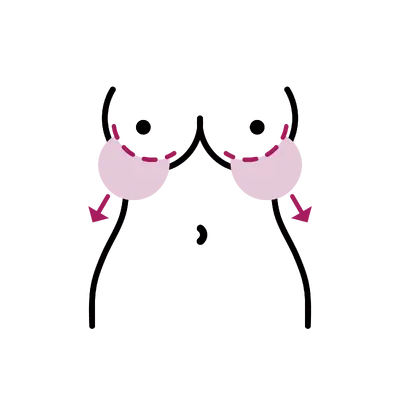
The bigger breast is reduced, lifted, or both to bring it down to match the smaller one. This avoids implants entirely and is a good option when the patient is happy with the size of the smaller breast. Scarring depends on how much tissue needs removing.
- Tissue removal and reshaping using vertical or anchor incisions
- Nipple repositioned to match the height of the opposite side
- Fat grafting can add subtle volume to the smaller breast if needed
- Best for: patients who prefer to match down rather than augment up
Combination Surgery (Both Sides)
The most common approach in practice. One breast is augmented while the other is reduced or lifted. Each side gets its own surgical plan, addressing differences in volume, shape, and nipple position simultaneously. This produces the most balanced outcome for complex cases.
- Each breast treated independently with the technique it needs
- May combine implant, lift, reduction, and fat grafting in one session
- Longer procedure but avoids the need for staged surgeries
- Best for: significant asymmetry involving differences in size, shape, and nipple position
Breast Asymmetry Correction Techniques
The technique on each side is chosen independently. What matters is matching the right approach to each breast, not applying one method across both.
Implant-Based Correction
A silicone implant is placed in the smaller breast to match the other side. The implant profile, width, and projection are selected specifically to close the gap. When the larger breast also needs minor reshaping, a different implant size or a small lift can be added to that side too.
- Implant size chosen by comparing both breasts, not by patient preference alone
- Dual-plane or submuscular placement depending on tissue coverage
- Can be combined with periareolar lift on the opposite side
- Best for: volume asymmetry where the smaller breast needs filling
Tissue Redistribution and Internal Reshaping
Internal scoring, flap rearrangement, or glandular reshaping redistributes existing breast tissue without removing it. This is used when the shape is the problem rather than the volume; one breast might be more constricted or tubular than the other.
- No implant required if volume is adequate on both sides
- Addresses shape discrepancies caused by constriction or tissue distribution
- Often combined with areola reduction if one side has a wider areola
- Best for: shape asymmetry where volume is roughly equal but distribution is uneven
Fat Grafting for Fine-Tuning
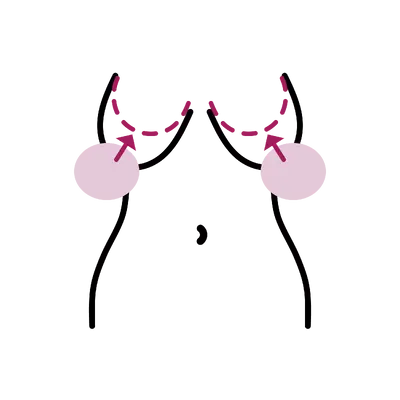
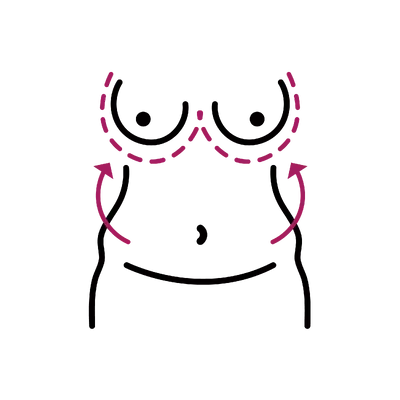
Fat transfer adds small volumes to fill contour dips or smooth irregularities that implants and lifts cannot fully address. It is rarely used as the primary correction method for asymmetry but works well as a finishing step to even out subtle differences after the main surgical work.
- Fat harvested from abdomen, flanks, or thighs via liposuction
- Injected in micro-droplets to maximise cell survival
- Typically adds half a cup or less; precision work, not volume work
- Best for: fine-tuning residual differences after implant or lift correction
Tuberous (Constricted) Breast Correction
A common cause of asymmetry is a tuberous, or constricted, breast on one side: a narrow base, a tight lower pole, and a puffy or enlarged areola. Correcting it means releasing the constricted tissue from the inside, expanding the lower pole, and reducing the areola, often with an implant or fat grafting to restore volume and shape. Because tuberous changes frequently affect only one breast, this is regularly part of an asymmetry plan rather than a separate operation.
- Internal release scores and expands the constricted lower pole
- Periareolar reduction brings a puffy or oversized areola back into proportion
- Implant or fat grafting restores volume to the released side
- Best for: asymmetry where one breast is tubular, constricted, or has a herniated areola
Round-Block (Benelli) Areola Correction
When the asymmetry includes a difference in areola size or a mildly low nipple position, a round-block technique reshapes and resizes the areola through a single incision around its edge, with a permanent purse-string suture holding the new diameter. It is a tidy way to match the areolas and lift the nipple slightly without the longer scars of a full vertical or anchor lift.
- Single incision hidden at the border of the areola
- Resizes a wider areola to match the opposite side
- Gives a modest lift without vertical or anchor scarring
- Best for: matching areola size or a small nipple-height difference between sides
Breast Asymmetry Correction Recovery Timeline
Week 1
Each breast recovers slightly differently depending on what was done to it. The augmented side tends to feel tight and sit high, while the reduced or lifted side may feel more tender along the incision lines. Swelling peaks around days 2–3. You will rest at your hotel with daily check-ins from your coordinator.
Weeks 2–4
Bruising fades and swelling starts to balance out between the two sides. The augmented breast begins to drop into a more natural position. Light activities and desk work can resume after two weeks. Avoid lifting anything heavy or sleeping on your front.
Months 1–3
Both sides continue settling and the symmetry becomes more apparent each week. Scars from lift or reduction incisions are still maturing. You can return to moderate exercise from about six weeks. The shape you see at three months is close to final but not the finished article.
Month 6+
Final symmetry is established as all swelling resolves and implants, if used, reach their permanent position. Scars fade to thin pale lines. The two sides should look balanced in and out of clothing, which is the whole objective.
When Can You Fly After Breast Asymmetry Correction?
Most patients can fly home 10–14 days after surgery. By that point the initial swelling has reduced, drains (if placed) have been removed, and your surgeon has checked both sides at a follow-up appointment. Cabin pressure will not affect your result at this stage. Wear a supportive surgical bra for the flight and move around the cabin periodically.
When Can You Return to Work and Exercise?
Desk-based work is usually fine after 10–14 days, once the early discomfort subsides. Light walking from day one is encouraged. Driving is typically back around 2 weeks, once you can brace and steer and perform an emergency stop without pulling on either side and you are off prescription pain relief. Gym work should wait until 4–6 weeks, and anything involving chest muscles or impact should be avoided for at least 6 weeks3. Each side may feel ready at different times; go by whichever side needs longer.
When Will You See Final Results?
You will notice a clear difference as soon as the surgical bra comes off, but the two sides will not look matched yet. Swelling resolves at different rates depending on what was done to each breast. Most patients see good symmetry by month 3, with final results at 6 months. If implants are involved, they take 3–4 months to settle into their permanent position.
Anaesthesia for Breast Asymmetry Correction
Breast asymmetry correction in Thailand is performed under general anaesthesia, so you are fully asleep and feel nothing throughout. This is the right choice here because the surgeon is often doing two different operations in one session, such as an implant on one side and a reduction or lift on the other, and that takes time and precise positioning. A consultant anaesthetist stays with you for the whole procedure and monitors you continuously, which is standard at the accredited hospitals we work with.
Because both breasts are treated as separate cases, the operation runs longer than a single-technique surgery, so general anaesthesia keeps you comfortable and still while the surgeon works through each side independently. Your surgeon and anaesthetist confirm the plan together based on how much work each breast needs and your medical history.
Before you are cleared, you have a pre-operative assessment that includes blood tests, a review of any medications you take, and the baseline breast imaging used to rule out an underlying cause for the asymmetry. You feel nothing during surgery. Afterwards each side tends to feel slightly different, with the augmented breast sitting tight and high and the reduced or lifted side tender along the incisions, but this is moderate discomfort rather than sharp pain and is well controlled with the medication your surgeon prescribes.
Risks and Safety of Breast Asymmetry Correction
This procedure combines multiple techniques, which means the risk profile reflects every component involved. Understanding what applies to your specific combination is important.
- Residual asymmetry that may require revision (some degree is normal)
- Capsular contracture on the implanted side if an implant is used1
- Scarring that varies between sides depending on the techniques applied
- Temporary or permanent changes in nipple sensation on either breast1
- Infection or haematoma at one or both surgical sites (uncommon)
- Seroma, a fluid collection under the skin, more likely with multiple incisions and sometimes needing drainage
- Fat necrosis if fat grafting is part of the correction
- Implant rupture or leak on the implanted side, which may need a further operation to replace the implant1
- Implant malposition or size mismatch requiring adjustment
- Differences in healing rate between the two sides
Because each breast undergoes different surgery, the risks are not identical on both sides. Your surgeon should walk through the specific risks for each breast during your pre-operative consultation.
Is Breast Asymmetry Correction Safe in Thailand?
Yes. When performed at a JCI-accredited hospital by a board-certified plastic surgeon, asymmetry correction in Thailand meets the same safety standards as private hospitals in the US, UK, and Australia. The key difference is access: shorter waits, lower cost, and surgeons who handle a higher volume of combination breast procedures than most Western counterparts.
How to Reduce Your Risk
Start with a JCI-accredited hospital, which guarantees international infection-control and safety protocols. Confirm your surgeon is certified by the Thai Board of Plastic and Reconstructive Surgery and has specific experience with asymmetry cases, not just standard augmentation. A thorough pre-operative assessment including mammography and blood work catches issues before surgery. Be direct about your expectations in the consultation so the surgical plan matches what you actually want.
When Is Revision Needed?
Some residual asymmetry after surgery is normal and expected; perfect symmetry does not exist in nature. Revision may be considered if there is a significant size mismatch, implant malposition, or a shape difference that does not improve after swelling resolves. Wait at least 6–12 months before evaluating, because both sides settle at different speeds and early results can be misleading.
Planning Your Trip to Thailand for Breast Asymmetry Correction
Most patients need 10–14 days in Thailand. Here is how to structure your trip, what is included, and where to recover.
How Long to Stay in Thailand
Allow a minimum of 10–14 days. Day 1–2 covers your consultation, pre-operative assessment, and surgical planning, which takes a bit longer for asymmetry cases because both sides need measuring independently. Surgery is followed by one night in hospital. The remaining days cover your initial recovery, drain removal if applicable, and a follow-up where your surgeon checks both sides before clearing you to fly.
What's Included in a Medical Trip
Your coordinator handles hospital transfers, scheduling, and interpreter services. The surgical quote covers the surgeon's fee, anaesthesia, hospital stay, implants if used, and post-operative follow-up. Flights and hotels are booked separately, but your coordinator can recommend accommodation close to the hospital. Everything is designed so you only need to focus on recovering.
Recovery in Bangkok vs Phuket
Bangkok is the practical choice. You are close to your surgical team for the follow-up appointments that matter most in the first two weeks. Asymmetry correction involves more post-operative checking than standard augmentation because each side heals differently. Some patients relocate to Phuket after the second week, but only do this once your surgeon has confirmed both sides are healing normally.
Related Procedures
Other procedures that address similar goals or conditions, in case one of them is a closer fit for you.
Planning your treatment in Thailand
Independent guides to help you weigh the decision, before you commit to anything.
Common Questions About Breast Asymmetry Correction
Everything you need to know before your procedure

Medical References
Keep researching with AI
Open this guide in your AI assistant to dig deeper and ask the questions it didn't answer.
Opens in a new tab with this guide already loaded.
Medical disclaimer: This information is for educational purposes only and does not replace professional medical advice. Individual results, recovery times, and suitability vary. Always consult a qualified surgeon before making decisions about treatment.
Ready to Get Started?
Speak with our care coordinators for a free, no-obligation consultation and personalised quote.
Speak to Our Team