Fat Transfer Breast Augmentation in Thailand Your guide to cost, top surgeons & hospitals
Your own tissue, moved to where you want it. No implants, no foreign material, just you.
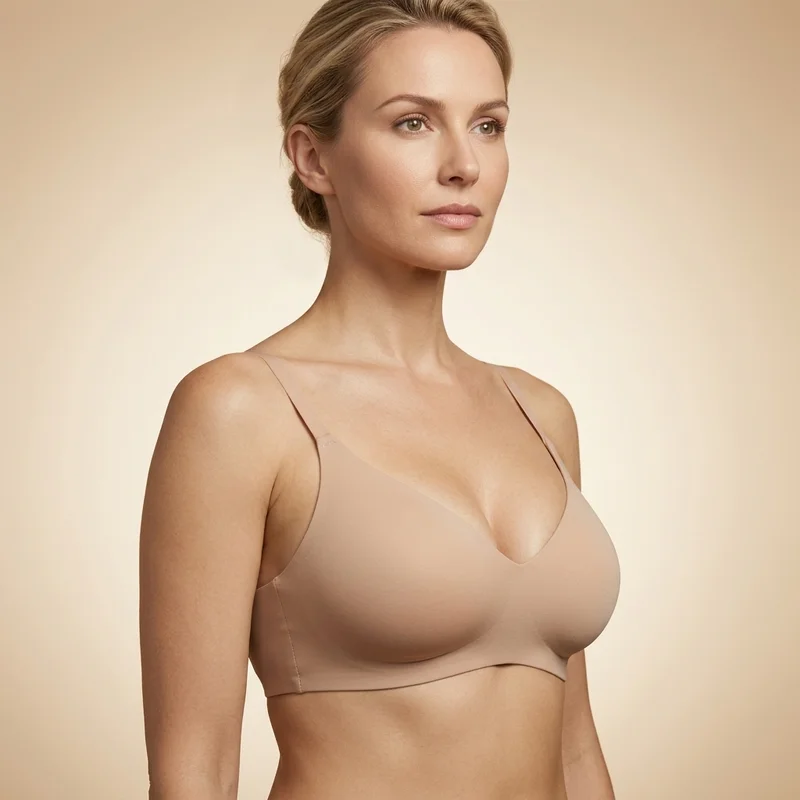
What Is Fat Transfer Breast Augmentation?
Also known as: Natural Breast Augmentation · Autologous Fat Breast Augmentation
Fat transfer breast augmentation is surgery that adds breast volume using your own fat, harvested by liposuction from the abdomen, flanks or thighs and injected into the breasts in tiny droplets so the cells pick up a blood supply and survive. No implants are used, so the result feels and moves like natural tissue. A single session usually adds about 1 to 1.5 cup sizes once the fat settles.
The honest trade-off is a little uncertainty, because not all the fat survives, so your surgeon overfills slightly to allow for reabsorption over the first few months.1,2 The early result looks fuller than the final one, which is normal. Some people add a second session once the first is stable.
This works best when you have enough fat to donate and want a modest, natural increase. If your goal is larger than two cup sizes, your surgeon will usually say so plainly and talk through whether implants suit you. A consultation is where they assess what is realistic.
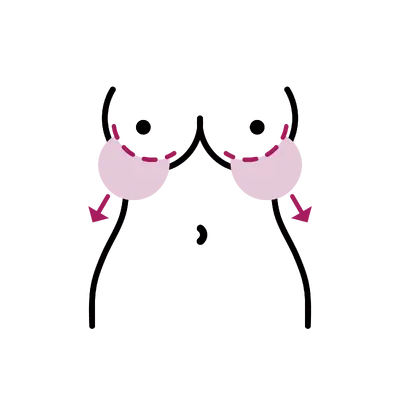
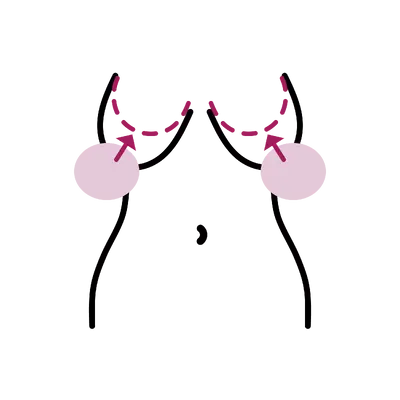
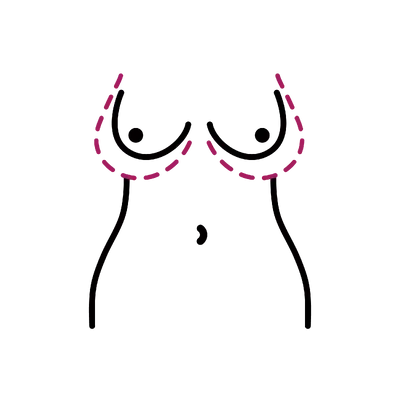
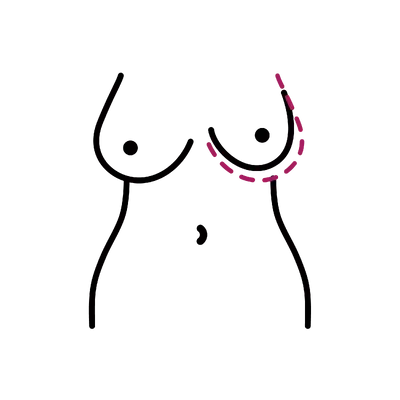
It can address a range of concerns, including:
Am I a Good Candidate for Fat Transfer Breast Augmentation?
Suitability for fat transfer comes down to what your body can donate and what you expect back; surgeons assess both honestly.
You can only transfer fat you actually have, which makes donor supply the first gate.
Harvestable deposits: Visible fat on the abdomen, flanks, or thighs is required, and the surgeon assesses this directly at consultation.
Very lean patients: Low body fat may simply mean not enough donor material; in that case implants are the honest alternative.
Dual benefit: Donor areas are contoured by the liposuction at the same time, so stubborn deposits you want removed work in your favour.
Fat transfer has hard volume limits, and surgeons look for goals that fit inside them.
1-2 cup sizes: A single session adds 1-1.5 cup sizes after settling; two sessions can reach 2 cup sizes in suitable patients.
Partial retention: Some of the transferred fat is reabsorbed in the first months, which is why surgeons overfill slightly.
Second session: Higher-end goals usually mean a second round 6-12 months after the first, once the graft has stabilised.
Beyond 2 cups: Wanting more than 2 cup sizes in one session is a sign implants are the better fit for the goal.
Transferred fat behaves like normal tissue, so your habits decide how much of it survives and stays.
Stable weight: Fluctuating weight is a caution flag; losing weight after surgery shrinks the transferred fat along with the rest of you.
Smoking: Nicotine significantly reduces fat cell survival in the breast, so quitting at least 4 weeks before surgery protects your investment.
Maintenance mindset: The result moves with your body long term, so candidates committed to a steady weight keep the best outcomes.
Fat grafting changes how future breast imaging reads, so your screening status matters up front.
History worked up: A personal or strong family history of breast cancer needs screening and workup before fat grafting proceeds.
Not pregnant or breastfeeding: Pregnancy and breastfeeding change the breast tissue and fat viability, so most surgeons advise waiting until at least 3-6 months after you have finished breastfeeding.
Baseline imaging: Pre-operative breast imaging establishes a reference point before any fat is introduced.
Future mammograms: Grafting can produce benign calcifications on later mammograms; these need flagging to your radiologist so imaging is read correctly.
Who is not suitable for fat transfer breast augmentation?
- Very lean patients without enough donor fat to harvest
- Expecting more than 2 cup sizes of increase
- Weight currently fluctuating or actively dieting
- Smokers unwilling to quit at least 4 weeks before surgery
- Unscreened personal or strong family history of breast cancer
- Pregnant or breastfeeding (wait until at least 3–6 months after weaning)
Pricing
How Much Will Fat Transfer Breast Augmentation Cost in Thailand?
What fat transfer breast augmentation costs at accredited hospitals in Thailand, and what your final quote depends on.
Get your exact price
Tell us what you're considering and we'll send a personalised quote from accredited hospitals within 24 hours.
Get my free quoteTypical prices in Thailand
Typical ranges based on recent hospital quotes. Your exact price depends on the hospital and how complex your case is, and is confirmed at your teleconsultation.
Fat Transfer Breast Augmentation
Every figure below includes the liposuction needed to harvest your own fat, so the fat removal is not charged on top.
| Single session, moderate volume Fat taken from one area, roughly 200 to 300ml per breast | $3,000 to $4,500 ฿102,000 to ฿153,000 |
| Single session, higher volume Fat taken from several areas for a bigger increase | $4,500 to $6,000 ฿153,000 to ฿204,000 |
| Fat transfer after implant removal Filling the pocket left behind once implants come out | $3,500 to $5,500 ฿119,000 to ฿187,000 |
Added to the above where needed
| Second-stage session Only if you top up the volume after the first round settles | $2,500 to $4,000 ฿85,000 to ฿136,000 |
Get your exact price
Tell us what you're considering and we'll send a personalised quote from accredited hospitals within 24 hours.
Hospitals Trusted for Fat Transfer Breast Augmentation
From internationally accredited flagships to dedicated specialist hospitals, these are the kinds of facilities where international patients have this procedure.
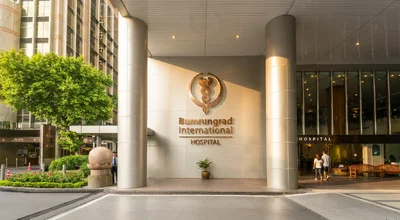
Bumrungrad International Hospital
Southeast Asia's flagship private hospital, treating over 520,000 international patients a year.
View hospital profile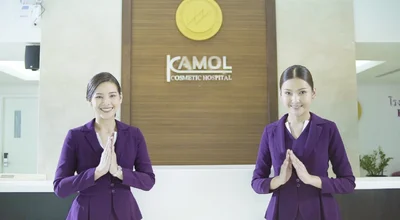
Kamol Cosmetic Hospital
The only specialist cosmetic surgery hospital in Thailand to hold JCI accreditation.
View hospital profile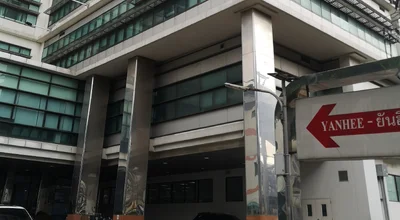
Yanhee International Hospital
A 400-bed hospital known worldwide for high-volume cosmetic surgery.
View hospital profile
Get a Free Quote in Two Minutes
Tell us what you're considering. We'll match you with suitable specialists and provide real hospital pricing.
- Honest pricing with no markups
- Matched to a specialist for your procedure
- No obligation, no pressure


Rated 5 stars by our patients
The complete guide to Fat Transfer Breast Augmentation in Thailand
Everything below is for readers who want the full detail: costs broken down, types and techniques, recovery, risks and safety, and planning your trip.
Fat Transfer Breast Augmentation Surgeons & Clinics in Thailand
Fat grafting is technique-dependent in a way that implant surgery is not. The surgeon's handling of fat at every stage determines how much volume you keep.
Leading Hospitals in Bangkok
Our partner hospitals have dedicated fat grafting facilities with the processing equipment needed for high-retention results: centrifuges, sterile preparation stations, and fine injection cannulas. These JCI-accredited international hospitals have plastic surgery departments that handle fat transfer as a routine procedure, not an occasional add-on.
Experienced Fat Transfer Surgeons
Our partner surgeons are board-certified by the Thai Board of Plastic and Reconstructive Surgery with specific training in autologous fat grafting techniques. Fat survival rates vary significantly between surgeons, and experience with micro-droplet injection is the main differentiator. Many of our partners publish their retention data and can show you before-and-after series with volume measurements.
What to Look for in a Surgeon
Ask about their fat survival rates and what processing method they use. A surgeon who cannot discuss retention figures probably does not track them. Look at before-and-after photos taken at 6 months or later. Early photos are misleading because reabsorption has not occurred yet. Ask how many fat transfer cases they perform monthly. This is a volume-dependent skill.
Understanding Your Results
Fat transfer results look most natural of all breast augmentation methods, but the timeline to final volume is longer because of the reabsorption phase.
Typical Fat Transfer Results
A successful single session adds roughly 1–1.5 cup sizes after fat stabilisation. The breasts feel completely natural because they are your own tissue. There are no implant edges, no capsule, and no foreign material. The donor areas are slimmer as a bonus. Two sessions can reach 2 cup sizes in suitable patients.
What Results Can You Expect?
In the first weeks, your breasts will look larger than the end result because the surgeon overfills to compensate for reabsorption. By month 3, the volume has reduced to its stable level. Some patients feel disappointed at this stage until they understand the reabsorption curve is normal. At 6 months, the fat is fully integrated. If more volume is wanted, a second session is planned from this baseline.
Fat Transfer Breast Augmentation Cost in Thailand
Average Cost of Fat Transfer Breast Augmentation
Fat transfer breast augmentation in Thailand typically costs between $3,000 and $6,000 per session. This covers the liposuction, fat processing, and injection components. Single-session cases with moderate volume goals sit at the lower end. Larger volume transfers or multiple donor sites push the price higher.
Cost Breakdown
The surgeon's fee covers the planning, liposuction, fat processing, and injection, a longer operative session than standard augmentation because two surgical areas are involved. Hospital fees cover the facility, anaesthesia, and monitoring. Aftercare includes compression garments for donor sites, medications, and follow-up appointments. There are no implant costs because no implants are used.
What Affects the Price?
The biggest variable is the volume of fat being transferred and how many donor sites are involved. More donor areas means more liposuction time. If you opt for staged procedures (two sessions months apart), each session is priced independently. The fat processing method can also vary in cost, though the difference is modest. Surgeon experience with fat grafting specifically, not just liposuction, is worth factoring in.
Thailand vs International Price Comparison
Fat transfer breast augmentation in Thailand costs 40–60% less than in the US ($8,400–$15,000), Australia (A$7,800–A$13,500), and the UK (£6,600–£11,400). The saving is significant because fat transfer involves two surgical components (liposuction and grafting), each of which carries its own fee at home. Our partner hospitals hold JCI accreditation with board-certified surgeons.
Non-Surgical Alternatives to Fat Transfer
Patients drawn to fat transfer for its implant-free, natural appeal often look first at non-surgical options. Hyaluronic acid breast fillers (such as the Macrolane-type injectables) add a small amount of volume without surgery, and vacuum suction systems like Brava or Noogleberry use sustained tissue expansion worn for hours a day over months. Both avoid an operation and a general anaesthetic, and PRP is sometimes added in an attempt to improve tissue quality.
The limits are significant. HA breast filler gives only a modest increase, is reabsorbed within roughly twelve to eighteen months, is expensive to maintain, and has fallen out of favour in many countries because the gel can obscure breast imaging and form lumps. Suction expansion needs months of disciplined daily wear for a subtle, easily-lost gain, since the tissue tends to recede once you stop. Neither builds lasting volume, removes donor-site fat, or restores the soft, permanent fullness that surviving grafted fat provides.
For a result that stays, feels like your own tissue, and adds a genuine one to two cup sizes, fat transfer is the route, since the surviving fat establishes its own blood supply and becomes a permanent part of the breast. That is what the rest of this page covers.
Types of Fat Transfer Breast Augmentation
The procedure itself does not vary as much as implant-based augmentation, but the goal and staging approach differ depending on what you are starting with and what you want to achieve.
Single-Session Fat Transfer
One round of liposuction and grafting in a single operation. This is the standard approach for most patients and adds 1–1.5 cup sizes after fat reabsorption settles. It works when you have enough donor fat and moderate volume goals.
- Fat harvested, purified, and injected in one session lasting 2–3 hours
- Surgeon overfills slightly to account for fat reabsorption
- Final breast volume visible at 3–6 months once surviving fat stabilises
- Best for: patients with adequate donor fat wanting a modest, one-step increase
Staged Fat Transfer (Multiple Sessions)
Two or more sessions spaced 6–12 months apart. Each round adds volume incrementally, allowing the breasts to adapt and giving the surgeon a stable baseline to work from. This approach reaches higher volumes (up to 2 full cup sizes) with better fat retention overall.
- First session establishes the vascular bed for fat survival
- Second session builds on retained volume for a larger total increase
- Total recovery is longer but each individual session is straightforward
- Best for: patients wanting the maximum possible increase without implants
Fat Transfer After Implant Removal
Used to restore volume after breast implants have been removed. The fat fills the pocket left by the implant and softens any contour irregularities from capsule tissue. This is increasingly popular among patients moving away from implants.
- Addresses the deflated appearance that follows explant surgery
- Fat fills the implant pocket and smooths tissue irregularities
- May require two sessions if the volume deficit is significant
- Best for: patients who have had implants removed and want volume restoration without new implants
Hybrid (Composite) Breast Augmentation
Combines an implant with fat transfer in a single operation. The implant provides the core volume and projection, while a layer of grafted fat is placed over the top to soften the edges and disguise rippling. This suits patients who want more size than fat alone can give but a softer, more natural feel than an implant on its own.
- Implant delivers the volume; overlying fat improves the look and feel
- Camouflages implant edges and rippling, especially in thin patients
- Reaches larger sizes than pure fat transfer in one procedure
- Best for: patients wanting implant volume with a softer, more natural-looking result
Fat Transfer Breast Augmentation Techniques
The technique centres on three stages: harvesting, processing, and injection. How each stage is handled directly affects how much fat survives and how even the result looks.
Harvesting and Donor Site Selection
Fat is extracted using low-pressure liposuction from areas with good fat deposits, typically the abdomen, love handles, or inner thighs. The extraction method matters because aggressive suction damages fat cells and lowers survival rates. Surgeons use gentle, manual, or power-assisted techniques to keep cells intact.
- Low-pressure or tumescent liposuction preserves fat cell viability
- Abdomen and flanks yield the highest volume; thighs are secondary
- Donor areas are contoured simultaneously; dual benefit from one procedure
- Best for: patients with visible fat deposits who want body contouring alongside breast enhancement
Fat Processing and Purification
Harvested fat contains blood, oil, and damaged cells that need separating out. The three main processing methods are centrifugation, filtration, and decanting. Centrifugation tends to produce the highest concentration of viable cells. The processed fat is then loaded into syringes for injection.
- Centrifugation spins fat to separate viable cells from oil and fluid
- Filtration and washing are alternative methods with slightly different retention profiles
- Only intact, healthy fat cells are transferred; debris and oil are discarded
- Best for: maximising the percentage of fat that survives long-term in the breast
Micro-Droplet Injection Technique
Fat is injected into the breast using small cannulas in tiny amounts (micro-droplets) across multiple tissue layers. This gives each fat particle contact with surrounding blood supply, which is essential for survival. Large bolus injections create dead zones where fat cannot get blood flow and dies off.
- Fat placed in 0.1–0.5ml increments across subcutaneous, glandular, and pectoral layers
- Multiple passes ensure even distribution and prevent lumping
- Surgeon works systematically to build volume layer by layer
- Best for: achieving the most even, natural-feeling result with the highest fat retention
Fat Transfer Breast Augmentation Recovery Timeline
Week 1
You are recovering from two surgical areas: the breasts and the liposuction donor sites. The donor areas often feel worse than the chest. Expect bruising across both areas and general soreness managed with prescribed medication. Compression garments are worn on the donor sites. Light walking from day one.
Weeks 2–3
Bruising fades noticeably and donor site discomfort improves. The breasts will look slightly larger than the final result because the body has not yet reabsorbed the fat that will not survive. Light desk work and gentle daily activities can resume. Avoid pressure on the breasts: no underwired bras or sleeping face down.
Months 1–3
Fat reabsorption happens during this window. The breast volume reduces slightly as the non-surviving fat is metabolised. The remaining fat establishes its own blood supply and becomes permanent. Donor sites also continue refining. Moderate exercise can resume from about six weeks.
Month 6+
What you see at six months is your result.2 The surviving fat behaves like normal breast tissue: it feels soft, moves naturally, and will fluctuate slightly with weight changes. If a second session was planned, it can be scheduled once the first round has fully stabilised.
When Can You Fly After Fat Transfer Breast Augmentation?
Most patients can fly home 7–10 days after surgery. By that stage the donor sites have settled enough for comfortable travel, and your surgeon has assessed the breast grafts at a follow-up appointment. Because liposuction under general anaesthesia carries a small risk of blood clots (DVT) that a long-haul flight adds to, wait for your surgeon's clearance before booking tight. Compression garments should be worn on the flight, stay well hydrated, and avoid sitting for prolonged periods, especially if thigh liposuction was performed; get up and move around the cabin.
When Can You Return to Work and Exercise?
Light desk work can resume after about a week. The donor sites may still be sore, so office clothing needs to be loose and comfortable. Walking is encouraged immediately. Gym workouts should wait until 3–4 weeks post-surgery, and anything that compresses the breasts (chest press, burpees, front-lying exercises) should be avoided for at least 6 weeks while the fat establishes blood supply.
When Will You See Final Results?
The breasts will look slightly overfilled for the first few weeks. Over months 1–3, the non-surviving fat is reabsorbed and the volume settles to its permanent level. What you see at 6 months is your result. If you planned a second session, it should be scheduled after this stabilisation period so your surgeon can accurately assess how much more volume to add.
Anaesthesia for Fat Transfer Breast Augmentation
Fat transfer breast augmentation in Thailand is performed under general anaesthesia, so you are fully asleep and feel nothing throughout. This is the right choice here because two surgical areas are worked on in one sitting: the donor sites where fat is taken by liposuction, and the breasts where it is injected. A consultant anaesthetist stays with you for the whole operation and monitors you continuously, which is standard at the accredited hospitals we work with.
Because the procedure usually runs two to three hours and involves liposuction across the abdomen, flanks, or thighs as well as the breast grafting, being fully under keeps you comfortable and still while the surgeon works methodically. Your surgeon and anaesthetist confirm the plan together based on how many donor sites are involved and your medical history.
Before you are cleared for anaesthesia you have a pre-operative assessment, including blood tests and a review of any medications or supplements you take, since blood thinners and fish oil are usually paused beforehand. You feel nothing during surgery. Afterwards, most patients find the donor sites ache more than the breasts: more a deep soreness than sharp pain, and well controlled with the medication your surgeon prescribes.
Risks and Safety of Fat Transfer Breast Augmentation
Fat transfer has a different risk profile to implant surgery. There are no implant-specific risks, but fat grafting introduces its own set of considerations.
- Fat reabsorption reducing final volume below expectations (some of the injected fat is reabsorbed)
- Fat necrosis: hardened lumps where injected fat did not survive1,2
- Oil cysts forming in areas of non-viable fat1
- Calcifications that may appear on future mammograms1
- Contour irregularities at donor sites from liposuction
- Seroma (fluid collection) at the liposuction donor sites, the most common donor-site complication; usually drained in clinic
- Infection at donor or injection sites (uncommon)
- Blood clots (DVT) or pulmonary embolism, a small but real risk after 2–3 hours of general anaesthesia and liposuction, relevant before a long-haul flight home2
- Asymmetry if fat survival differs between breasts
- Need for a second session to reach desired volume
The main risk patients underestimate is volume loss from reabsorption. Your surgeon should set clear expectations about realistic size gain during consultation. Fat necrosis and calcifications are generally benign but should be disclosed to your radiologist for future breast imaging.
Is Fat Transfer Breast Augmentation Safe in Thailand?
Yes. Fat transfer to the breast is a well-established procedure with a strong safety record when performed by experienced surgeons at accredited facilities. Our partner hospitals are JCI-accredited with dedicated plastic surgery departments. The procedure avoids all implant-related risks, though fat grafting has its own considerations which your surgeon will cover in detail.
How to Reduce Your Risk
Choose a surgeon with specific fat grafting experience; liposuction skill alone is not enough. The injection technique determines fat survival and whether complications like fat necrosis occur. A JCI-accredited hospital ensures proper sterile processing of the harvested fat. Pre-operative assessment should include breast imaging to establish a baseline before fat is introduced. Follow compression garment instructions carefully for the donor sites; consistent compression also reduces the seroma (fluid collection) that liposuction sites are prone to. Because this is a 2–3 hour general anaesthetic with liposuction, there is a small risk of blood clots: keep mobile from day one, stay well hydrated, and follow any blood-thinning advice your surgeon gives, especially before your flight home.
Will Fat Transfer Affect Future Mammograms?
Fat transfer can produce calcifications that show up on mammograms. These are benign, but they need to be distinguished from other findings. Inform your radiologist that you have had fat grafting so they can read the imaging correctly. Experienced radiologists can differentiate fat graft calcifications from concerning findings. This is not a safety risk; it is a disclosure step that matters for accurate screening.
Planning Your Trip to Thailand for Fat Transfer Breast Augmentation
Most patients need 7–10 days in Thailand. The recovery is lighter than implant surgery, but you are healing from two areas: breasts and donor sites.
How Long to Stay in Thailand
Plan for 7–10 days. Day 1 covers your consultation and donor site assessment. Surgery typically happens within a few days. You will need one night in hospital or be discharged the same day depending on the scope. The rest of your stay covers recovery and a follow-up appointment where your surgeon checks both the breasts and donor areas before clearing you to travel.
What's Included in a Medical Trip
Your coordinator manages scheduling, hospital transfers, and interpreter services if needed. The surgical quote covers the surgeon's fee, anaesthesia, fat processing, compression garments, and follow-up visits. Flights and hotels are arranged separately. Your coordinator can recommend hotels within easy reach of the hospital for the post-operative days when you will want to rest.
Recovery in Bangkok vs Phuket
Bangkok makes the most sense for fat transfer because you want to be near your surgeon for the follow-up check. Donor site issues (seromas, uneven contour) are easier to address early if you are close to the hospital. After your follow-up clearance at 7–10 days, some patients add a few days in Phuket to relax before flying home. Keep wearing compression garments on the donor sites regardless of location.
Related Procedures
Other procedures that address similar goals or conditions, in case one of them is a closer fit for you.
Planning your treatment in Thailand
Independent guides to help you weigh the decision, before you commit to anything.
Common Questions About Fat Transfer Breast Augmentation
Everything you need to know before your procedure

Medical References
Keep researching with AI
Open this guide in your AI assistant to dig deeper and ask the questions it didn't answer.
Opens in a new tab with this guide already loaded.
Medical disclaimer: This information is for educational purposes only and does not replace professional medical advice. Individual results, recovery times, and suitability vary. Always consult a qualified surgeon before making decisions about treatment.
Ready to Get Started?
Speak with our care coordinators for a free, no-obligation consultation and personalised quote.
Speak to Our Team