How Round and Teardrop Implants Differ
Implant shape is one of the key choices in breast augmentation, and the two main options are round and teardrop (also called anatomical or form-stable). The distinction is straightforward in concept but has meaningful implications for the final look.
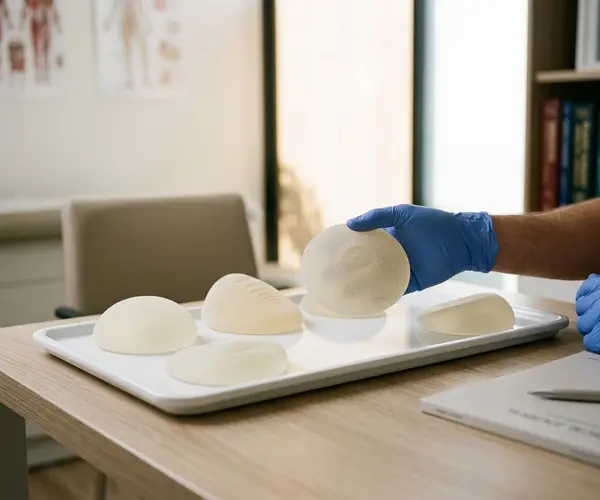
Round implants are symmetrical. Because volume is distributed equally, there is no "wrong way up." They tend to add fullness across the entire breast, particularly the upper pole, which creates a rounder, more projected appearance. When a patient lies down, round implants settle in a way that can look quite natural because gravity redistributes the fill.
Teardrop implants are designed with less volume at the top and more at the bottom, mimicking the natural gradient of breast tissue. Standing upright, they produce a gentle slope from the collarbone down to the point of maximum projection near the lower breast. The result often appears more understated.
The Case for Round Implants
Round implants remain the most widely used shape worldwide. Their popularity reflects several practical advantages. Because they are symmetrical, there is no risk of rotation causing a visible distortion. If a round implant shifts position slightly within the pocket, the shape does not noticeably change.
Modern cohesive silicone gel rounds also behave differently from older models. High-profile and ultra-high-profile round implants can actually mimic a teardrop shape when placed upright because the gel settles toward the lower pole under gravity. This means many patients who want a natural slope can still achieve it with a round implant, depending on tissue coverage and implant profile.
Round implants are available in a wider range of sizes and profiles, giving surgeons more flexibility during planning. They are also compatible with both saline and silicone fill options.
The Case for Teardrop Implants
Teardrop implants can be an excellent choice for patients seeking a subtle, anatomically faithful result, particularly those with minimal native breast tissue. The built-in shape means less reliance on gravity and tissue drape to create a natural slope.
They tend to be made with a highly cohesive ("gummy bear") silicone gel that holds its form well. This form stability means the implant maintains its intended contour even when the patient changes position.
The primary concern unique to teardrop implants is rotation. Because the shape is asymmetrical, any rotation within the breast pocket can lead to a visible distortion. To reduce this risk, teardrop implants typically have a textured surface that encourages tissue adherence. However, textured surfaces have been the subject of ongoing clinical discussion regarding a rare association with certain conditions, so this is an important point to discuss with your surgeon.
How to Choose Between Them
Several factors guide the decision. Patients with adequate breast tissue often achieve natural-looking results with either shape. Those with very little tissue may find that a teardrop implant offers a more realistic contour, though submuscular placement of a round implant can achieve a similar effect.
Your desired aesthetic matters. If you prefer a fuller, more rounded look with visible upper-pole volume, round implants are the more direct route. If you want a gentle slope with projection focused lower, a teardrop may suit you better.
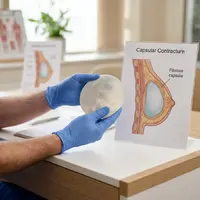
Surgeons also consider chest width, skin elasticity, and whether capsular contracture risk factors favour one surface texture over another. There is no single correct answer, and the best implant shape is the one your surgeon recommends after a thorough physical assessment of your anatomy and a clear understanding of your goals. Consult your surgeon to determine which shape aligns with your expectations.