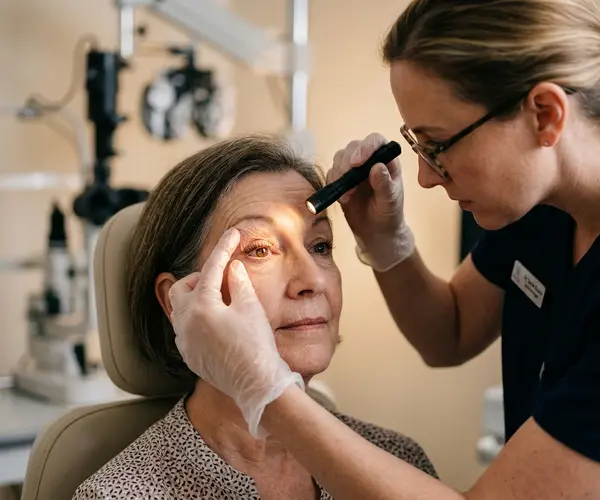
What the Procedure Involves
Double eyelid surgery is a blepharoplasty technique designed to create a crease in the upper eyelid. The upper eyelid naturally contains a structure called the levator aponeurosis, which attaches to the skin to form a visible fold when the eye opens. In patients with a monolid, this attachment is absent or positioned differently, resulting in a smooth eyelid without a defined crease.
The procedure establishes this connection surgically, allowing a fold to form when the eyes are open. The position, height, and depth of the crease can be customised based on the patient's anatomy and aesthetic goals. Consult your surgeon about which crease style would complement your facial features.
Incisional Technique
The incisional approach involves making a precise cut along the planned crease line on the upper eyelid. Through this incision, the surgeon can remove excess skin, orbicularis oculi muscle, and orbital fat as needed. The deeper eyelid tissue is then sutured to the skin edge, creating a defined and lasting attachment point. Because the surgeon can directly visualise and modify the underlying structures, this method offers a high degree of control over the final result.
The incisional technique is generally recommended for patients with thicker eyelid skin, significant excess fat in the upper lid, or those who want a well-defined crease. The resulting scar sits within the new fold and typically fades to a faint line over several months.
Non-Incisional Suture Technique
The non-incisional method uses buried sutures passed through small puncture points in the eyelid skin. These sutures create an adhesion between the skin surface and the deeper tarsal plate or levator aponeurosis, forming a crease without removing any tissue. The procedure is faster, involves less swelling, and has a shorter recovery period compared to the incisional approach.
This technique works best for younger patients with thin eyelid skin and minimal excess fat. However, because no tissue is removed, the crease formed by sutures alone may gradually weaken over time in some patients, particularly those with heavier lids.
Who Is a Suitable Candidate
Patients who seek double eyelid surgery typically have a monolid, a partial crease that appears and disappears, or asymmetric folds between the two eyes. The procedure is not limited to any single ethnic group, though it is most commonly performed on patients of East Asian and Southeast Asian heritage.
Good candidates are in overall good health, have realistic expectations about the outcome, and understand that the goal is enhancement rather than a dramatic transformation. Age is generally not a limiting factor, though adolescent patients should have completed facial growth. A thorough consultation with a qualified surgeon will determine the most appropriate technique and crease design for each individual.
Choosing a Crease Style
The appearance of the final crease depends on several factors, including its height above the lash line, whether it follows an in-fold or out-fold pattern, and how deeply it is set. A lower, narrower crease produces a subtle result that looks natural on most Asian facial structures. A higher, more defined crease creates a more dramatic effect. The surgeon will assess your eyelid anatomy, brow position, and facial proportions during the consultation to recommend a crease design that suits you.