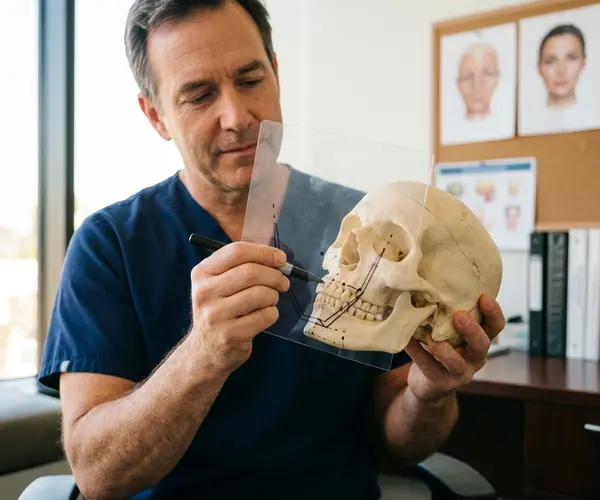
The V-Line Concept
The term V-line refers to a facial silhouette in which the lower face tapers smoothly from the cheeks down to a narrow, gently pointed chin, forming a shape that resembles the letter V when viewed from the front. This contour is widely considered aesthetically desirable in many East Asian beauty standards and has gained global popularity as facial contouring surgery has become more accessible.
Achieving a V-line typically requires addressing two areas simultaneously. The jaw angles, which create width at the sides of the lower face, are reduced through bone shaving. The chin tip is then refined, narrowed, or advanced using an osteotomy to complete the taper. Performing both steps together ensures the lower face transitions smoothly from ear to chin without abrupt angles or disproportionate segments.
How the Surgery Is Performed
V-line surgery is performed entirely through incisions inside the mouth, so there are no visible external scars. The surgeon first addresses the jaw angles using a sagittal split osteotomy or direct bone shaving to remove the protruding mandibular angles. The outer cortical bone along the jaw body may also be burred to create a gradual, natural contour rather than an abrupt transition between the reshaped angle and the rest of the jaw.
The chin is then reshaped using a T-shaped or V-shaped osteotomy at the front of the mandible. The bone segment is narrowed by removing a central wedge and bringing the two sides together, and it may be shortened or advanced depending on the patient's proportions. Titanium plates and screws secure everything in position.
The entire procedure generally takes two to three hours under general anaesthesia. Because both the jaw angles and chin are addressed through intraoral incisions, all surgical access points are hidden inside the mouth.
Who Is a Good Candidate
Ideal candidates for V-line surgery have a wide, square, or heavy lower face and want a slimmer, more tapered profile. Patients with a combination of prominent jaw angles and a broad or long chin tend to benefit most, as the procedure addresses both areas in a single operation.
Facial bone growth should be complete before undergoing this surgery, which typically means patients should be at least 18 years old. Good general health, realistic expectations, and a clear understanding of the permanent nature of bone contouring are essential. Patients who primarily need chin projection rather than narrowing may be better served by an implant or isolated genioplasty rather than full V-line surgery.
V-Line Surgery and Facial Harmony
Successful V-line contouring depends on careful pre-operative planning that considers the entire face rather than the lower third in isolation. The relationship between the forehead, cheekbones, and chin and jaw determines how much reduction and reshaping is needed to produce a balanced result. Over-reduction of the jaw angles or chin can create an unnatural appearance, so experienced surgeons use imaging, measurements, and sometimes 3D planning to calibrate the degree of change.
Masseter muscle reduction using botulinum toxin is sometimes recommended before or after V-line surgery to address soft tissue bulk that contributes to jaw width beyond what bone surgery alone can correct.
What to Expect Afterward
Swelling after V-line surgery is significant, particularly in the first week, and the lower face will appear wider than the final result during this period. Most visible swelling resolves within three to four weeks, though subtle residual puffiness can persist for several months. The final V-line contour is typically fully apparent by six months.
Consult your surgeon about what degree of change is realistic for your bone structure and how the healing timeline applies to your specific case.